
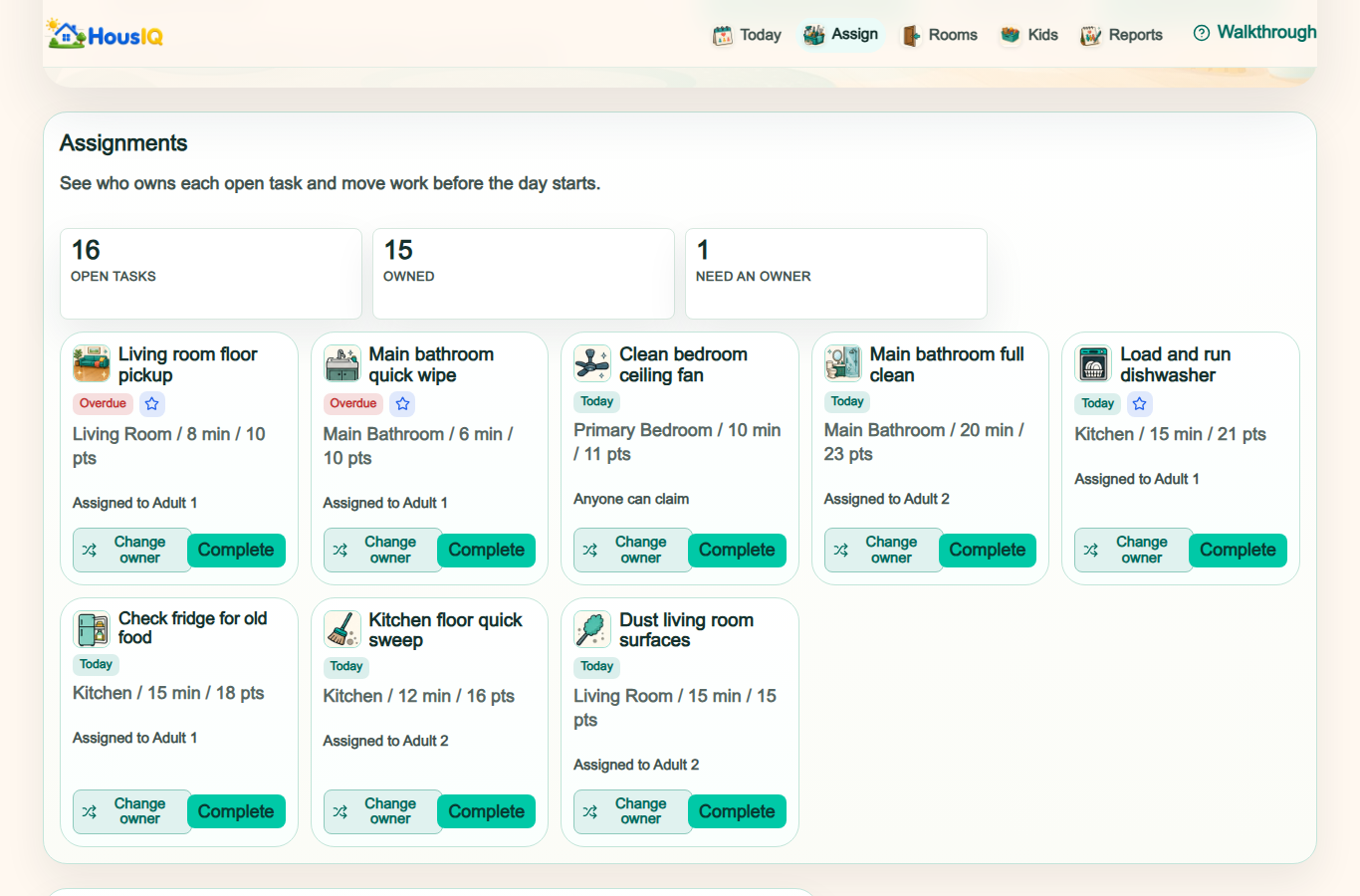
Most households organise chores as a to-do list, and a to-do list is the wrong shape for the problem. A to-do list is designed for things that get finished. Household work never finishes: it recurs, at different rates, in different rooms, and the list only ever grows.
Frequency first, because it changes everything else
A single flat list of household tasks is unusable within a month. Descaling the showerhead sits next to emptying the dishwasher, and the daily jobs get lost among quarterly ones that are individually much larger. Split by how often the job recurs before organising anything else. Daily, weekly, monthly, seasonal. Each behaves differently and needs a different kind of prompt.
- Daily: compounds overnight, needs a fixed reset slot
- Weekly: no natural trigger, needs a fixed day
- Monthly: easy to forget entirely, needs a date
- Seasonal: needs a reminder months ahead, not a list
Attach jobs to rooms
Rooms are the natural unit of household work, because you are already standing in one with the right equipment to hand. Organising by room turns 'clean the floors' into one contained job in one place with a clear end. It also makes the list generative rather than something you have to invent: walking through a room and asking what recurs here produces a far more complete list than trying to remember chores in the abstract.
Every recurring job needs one name
A job owned by everyone is done by whoever minds most. That is not a plan, it is a default, and it is where uneven households come from. One name per recurring job. Rotate deliberately if you want, but rotate on a schedule rather than leaving it open, because 'whoever gets to it' resolves to the same person every time.
Write down what finished means
Most disagreements about chores are definitional rather than about effort. 'Tidy the kitchen' means wiped counters to one person and includes the hob, sink, and floor to another. One line per recurring job is enough, and it retires the argument permanently.
Separate what recurs from what happens once
Genuine one-offs, booking a service or fixing a handle, do not belong in the recurring system. Mixed in, they either clutter the routine or vanish into it. Keep them apart. The recurring list should be almost entirely stable from week to week, which is what lets you notice when something is wrong with it.
Review the misses, not the list
Once it is running, the useful signal is which jobs keep being skipped and which keep returning to the same person. Those two patterns tell you what to change. A job missed three times running is scheduled wrong. A job that always comes back to one person is owned wrong. Neither is a motivation problem, and treating them as one is how households end up arguing instead of fixing.
Questions families ask before choosing
Should household tasks live in a to-do app?
Only if it handles recurrence properly. A to-do list is built for things that get finished, and household work never does, so the list grows indefinitely and people stop trusting it.
Is it better to organise by room or by task type?
By room for most households. You are already in the room with the right equipment, the job has a clear end, and walking through a room is a much better way to produce a complete list than trying to recall chores in the abstract.
How do I stop the list becoming overwhelming?
Split it by frequency and only ever look at today's slice. A complete household list is long by nature; the daily view of it should be short.
What do I do about tasks nobody ever completes?
Change the schedule before questioning the person. A job skipped repeatedly is usually on the wrong day or too large. Change one thing at a time or you will not learn which it was.