
Uneven housework usually shows up long before anyone says it clearly. The pattern is quiet, it builds slowly, and by the time someone finally raises it the conversation is about resentment rather than about chores. The signs below are the ones that tend to appear first, while the imbalance is still fixable.
One person notices everything first
In most uneven households, one partner is the smoke alarm. They see the bin is full, that the towels need changing, that there is nothing for tomorrow's lunch. The other partner is willing to help and genuinely does help, but only after being told. This is the sign people miss, because noticing does not look like work. It has no start, no finish, and nothing to point at afterwards. It is still the most tiring part of running a home, because it never switches off.
- One person is asked what needs doing; the other is the one being asked
- Jobs get done well but only after a prompt
- One partner can relax in a messy room and the other cannot
Shared chores still have a manager
A chore can be split on paper and still sit with one person, because someone has to plan it, sequence it, and check it happened. If laundry is shared but one partner decides when a wash goes on, which pile is next, and whether it made it back into the wardrobe, that job is not shared. It is delegated, and delegation is work. The test is simple. If one person stopped tracking it for two weeks, would it still happen?
The same jobs keep coming back to the same person
Over a month, most households develop a shape. Certain chores land on one person almost every time, regardless of any agreement. Often they are the jobs that are unpleasant, invisible, or must be done at an inconvenient hour. This matters more than the overall count, because it is the part that feels unfair even when the totals look reasonable. Doing half the work is tolerable; doing the same disliked half every week is not.
Time off is not equally free
Compare what a Saturday morning looks like for each person. If one partner's free time is genuinely free and the other's is interrupted by jobs that cannot wait, the household is not evenly loaded no matter what the chore list says. Rest that has to be scheduled around household work is not the same as rest, and this difference is usually invisible to the person whose time is actually free.
Standards get treated as a preference
A common pattern is that one person's standard becomes 'their thing' rather than the household's baseline. Once that framing sticks, everything above the lower standard becomes optional work done by choice, which quietly makes it that person's responsibility. Agreeing a shared baseline, even a low one, moves the work back to being the household's rather than one person's preference.
What to do once you can see it
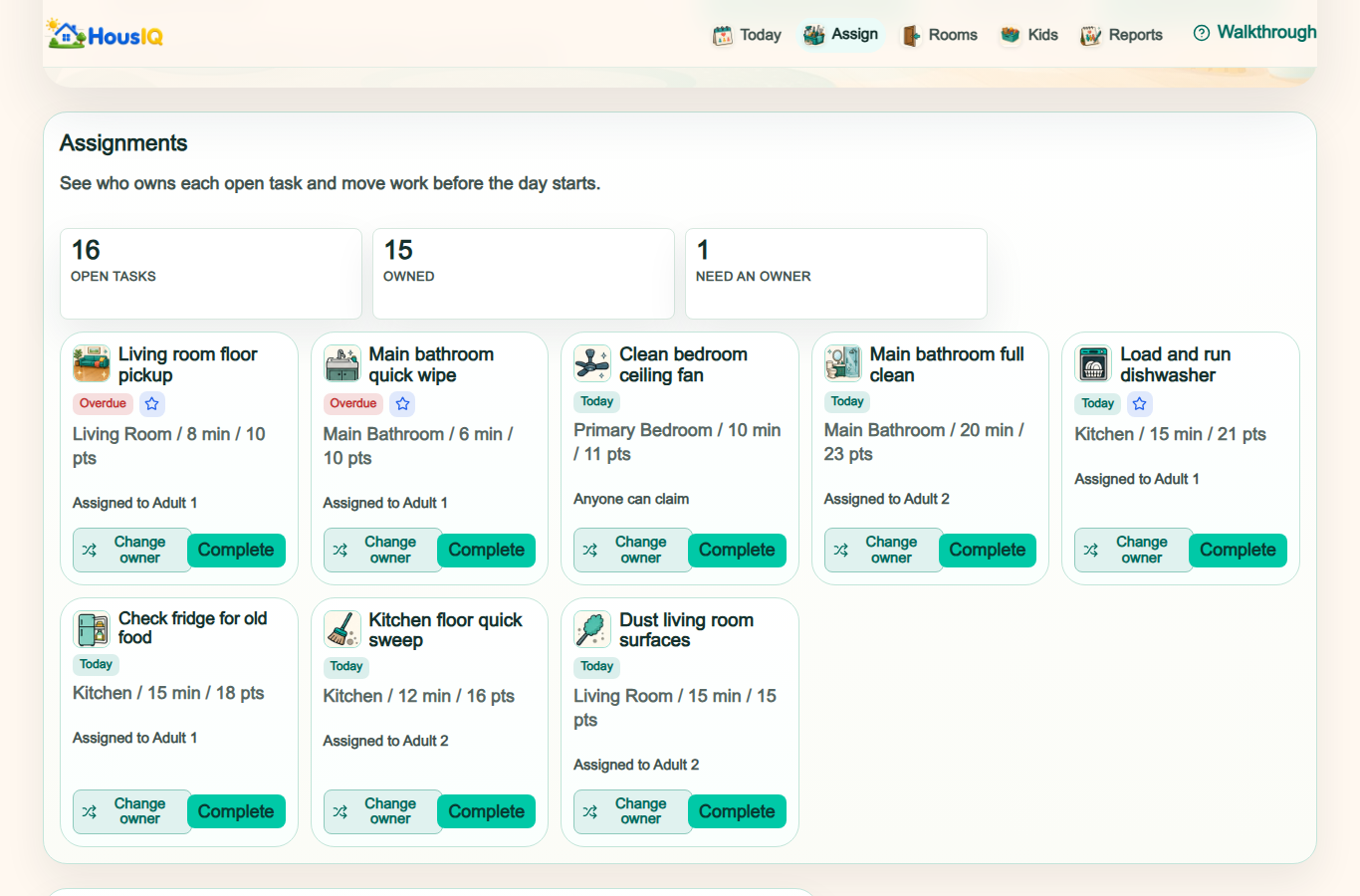
Do not open with the totals. Start with the specific jobs that keep returning to the same person, because those are concrete and hard to argue about. Then move the list somewhere both people can see it, so that noticing stops being one person's job. The goal is not to prove who did more. It is to make the pattern visible enough that it stops needing to be argued at all.
Questions families ask before choosing
Is keeping track of chores really work?
Yes. Planning, scheduling, remembering, and following up take attention continuously, unlike a task that starts and finishes. It is the part of household work most likely to be uneven and least likely to be counted.
How do I raise this without starting an argument?
Lead with a specific recurring chore rather than a general claim about effort. 'The bins have come back to me every week this month' is checkable and hard to dispute. 'I do everything' invites a defence rather than a fix.
What if we genuinely disagree about standards?
Agree a shared minimum rather than arguing toward one person's standard. Anything above the agreed baseline is then genuinely optional, and anything below it is a household problem rather than one person's preference.
Does tracking chores make it worse?
It usually helps, because it replaces an argument about impressions with a record of what happened. What makes it worse is tracking used to build a case rather than to rebalance the work.