
Fair chore division rarely fails because nobody wants to help. It usually fails because the recurring work is vague, invisible, and easy to underestimate. Most households try to fix it by splitting tasks down the middle, which sounds fair and almost never holds, because a fifty-fifty list of chores is not a fifty-fifty split of effort, timing, or the thinking behind either.
Write down the invisible work first
Every household underestimates the same category: short, frequent, low-status jobs. A deep clean of the oven is memorable and takes ninety minutes four times a year. Wiping the counters takes six minutes and happens seven hundred times a year, which is seventy hours. The second job is far larger and almost never appears on a chore list. Before dividing anything, spend a week writing down what actually gets done, including the jobs that take under five minutes. Most people are surprised by the length of the list, and the person who has been carrying it is usually surprised for a different reason.
- Daily resets: counters, sink, visible clutter, dishes in and out
- Repeating admin: post, appointments, school forms, refills, restocking
- Trigger jobs nobody schedules: the bin is full, the towels smell, we are out of milk
- Noticing work: realising a job needs doing before anyone else has seen it
Split by time and frequency, not by task count
Four chores each looks even on paper and rarely is. Compare the real load instead: multiply how long a job takes by how often it repeats, and split on the total. A weekly forty-minute job is a smaller commitment than a five-minute job done every day. This is also the calculation that settles most arguments about fairness, because it replaces a feeling with a number. Nobody has to be believed; the arithmetic is either even or it is not.
Give every chore one named owner
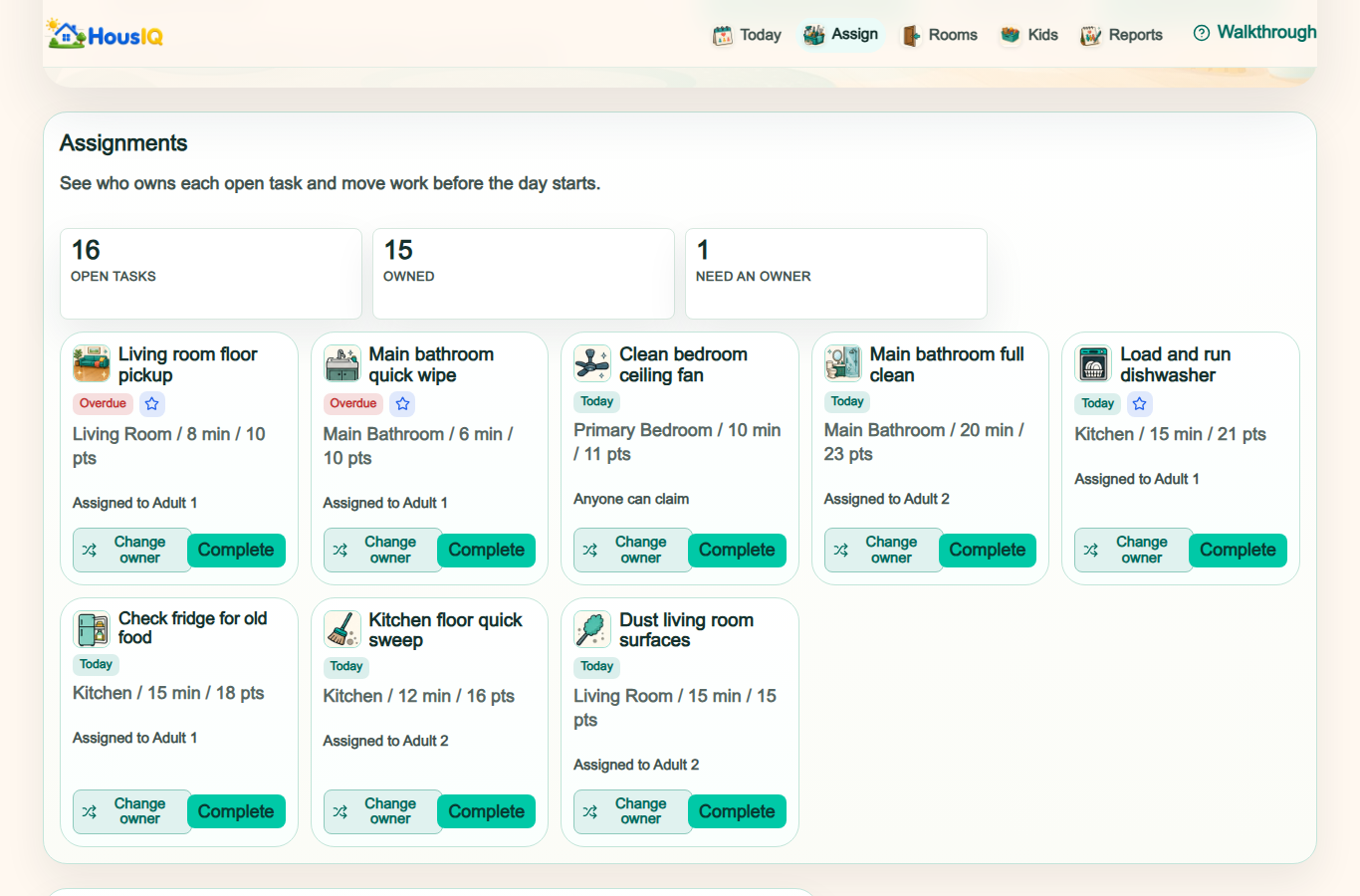
Shared ownership is the most common cause of a chore quietly reverting to whoever minds most. If a job belongs to everyone, it belongs to the person with the lowest tolerance for it being undone, and that person is doing it by default rather than by agreement. Name one owner per recurring chore. Rotate the ownership if you want to, but rotate it explicitly rather than leaving it open. A job with a name attached gets done or is visibly not done, and both outcomes are more useful than a job that silently lands on the same person.
Divide the noticing, not just the doing
The heaviest part of household work is often not the task. It is holding the list: knowing the bins go out tonight, that the school trip needs paying for, that the guest bed needs making before Friday. Two people can do an identical number of chores while only one of them is tracking what needs doing. The fix is to move the list out of one person's head and somewhere both people can see it. Once the schedule exists outside a person, remembering stops being a job, and the split stops depending on one person's memory.
Account for capacity honestly
An even split is not always a fair one. Shift work, commutes, study, illness, and caring for someone else all change what a person can realistically carry, and a split that ignores them collapses within a fortnight. Agree what each person can genuinely take in a normal week, then divide against that rather than against an ideal. It is better to agree an uneven split openly than to agree an even one and watch it fail quietly.
Review after two weeks, using what actually happened
A split is a hypothesis. The only thing that tests it is a fortnight of ordinary life, including the bad days. Review what was actually completed, by whom, rather than what was assigned. Look for chores that keep returning to the same person regardless of the agreement. Those are the ones to reassign first, because a chore that always comes back is telling you something the plan did not account for.
Questions families ask before choosing
What is a fair split when one person works longer hours?
Divide against available time rather than clock hours at work. Someone working fifty hours with a short commute may have more household capacity than someone working forty with two hours of travel. Agree what each person can carry in a normal week, then split against those numbers.
How do we stop the same chores coming back to one person?
Name a single owner for each recurring chore and rotate ownership on a schedule rather than by whoever notices first. Then check after a fortnight which chores still returned to the same person anyway, and reassign those specifically.
Should children be included in the split?
Yes, with jobs matched to age and no chemicals, heights, blades, or hot surfaces. Children carrying a small, genuinely theirs share is more useful than a token task, and it removes real work from the adults rather than creating supervision work.
How often should we revisit the division?
Two weeks after any change, then roughly every season, or whenever a schedule shifts. Most splits fail slowly rather than suddenly, so the review matters more than the original agreement.